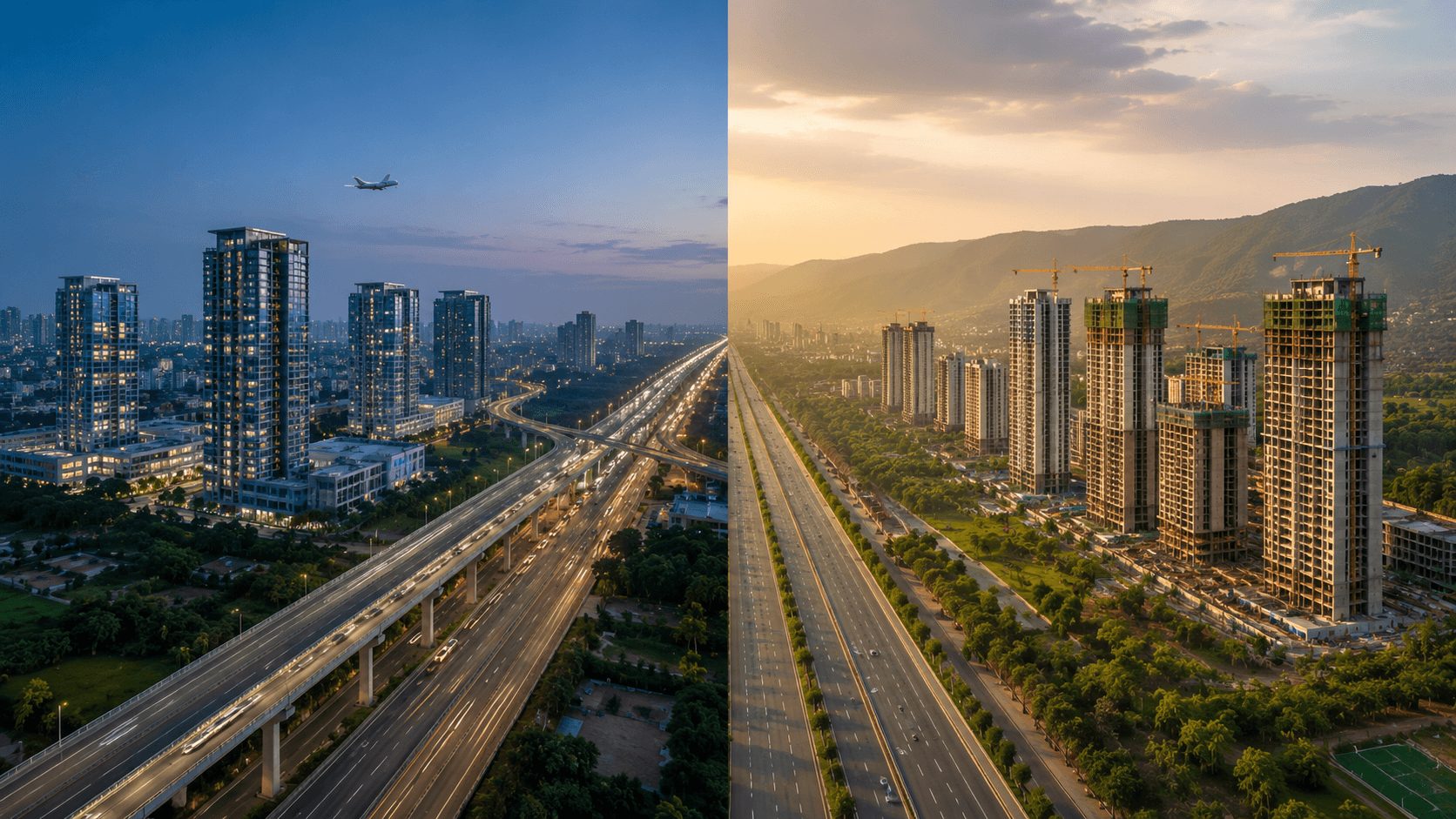

You have been watching Gurgaon's property market. Prices have risen sharply, 113% in five years across the city, more on premium corridors. Part of you wonders whether this run can continue. Another part wonders whether waiting for a correction is a strategy or just procrastination dressed up as patience.
This is the most honest question in Gurgaon real estate right now. And it deserves a direct, data-backed answer, not a sales pitch from a developer and not vague reassurance about the right time to buy.
Here is what the evidence actually says.
First, Let Us Understand What Drives Gurgaon's Prices
Before deciding whether to buy or wait, you need to understand why prices have moved the way they have, because that tells you whether the forces driving them are structural or speculative.
Property prices in Gurgaon showed 160% growth between 2019 and 2024, and forecasts for 2026 suggest appreciation will remain at 10 to 15%, driven by employment-creating demand rather than speculation. That is not bubble territory. That is a market with genuine underlying drivers.
Those underlying drivers are: GCC and MNC expansion creating high-income employment, infrastructure delivery on Dwarka Expressway and SPR re-rating previously undervalued corridors, post-pandemic preference for larger homes with better amenities, and NRI participation increasing as India's economic story strengthens globally.
None of these are cyclical sentiment drivers. These are structural changes in how people live, work, and invest in Gurgaon, and structural changes do not reverse because a buyer decides to wait.
Is a Price Correction Actually Coming?
Let us be direct about this. Some buyers are waiting for a 20 to 30% price drop before entering the market. Here is what the evidence says about whether that is a realistic scenario.
A 30 to 40 percent drop in prime Gurgaon corridors is a statistically unlikely outcome given the structural demand drivers at play. If you are waiting for a crash before you buy, you might be waiting for a very long time.
Distress sales in premium gated communities by Tier-1 builders are statistically rare in 2026 because buyers utilize low debt-to-equity ratios. The strategy should shift from waiting to selecting credible Grade-A builders in infrastructure-backed micro-markets.
The market has stabilised after 2025 adjustments. Infrastructure projects are maturing and pricing remains reasonable before the next major appreciation cycle. However, waiting for further price corrections in a rising market can mean missing optimal entry points. If fundamentals are strong and pricing is reasonable, acting decisively is wise.
The nuanced truth is this: a dramatic, broad-based correction is unlikely. But selective softening in oversupplied sectors, in projects from less credible developers, in areas without confirmed infrastructure, is already happening and will continue.
The correction, if it comes, will be surgical. Not sweeping.
What Waiting Actually Costs You
Most buyers who are waiting think of it as a costless decision. It is not. Waiting has a very specific financial cost and it compounds the longer you wait.
Gurgaon's market is currently appreciating at 10 to 15% annually on established corridors. If you are planning to buy a Rs 3 crore flat and you wait twelve months, you are not buying the same flat for Rs 3 crore next year. You are likely buying it for Rs 3.3 to Rs 3.45 crore.
That Rs 30,000 to Rs 45,000 monthly premium, the cost of waiting a year, is money you are spending whether you buy now or not. The only question is whether you spend it building equity in an asset you own, or paying rent while hoping for a correction that the data suggests is unlikely to be significant.
Industry analysts advise buying in Gurgaon's established or rapidly developing sectors now, as prices in prime locations are unlikely to correct and waiting typically results in paying a higher entry price.
Waiting only helps if something changes in your favour, whether that is pricing, income, or clarity. Otherwise, it simply delays the same decision.
Where the Market Is Genuinely at Risk: The Honest Picture
This would not be an honest assessment without acknowledging the pockets where caution is genuinely warranted.
Gurgaon is no longer expanding evenly. Specific corridors are performing strongly while others are moving slowly. Understanding this difference is important if you are planning to buy, invest, or sell property in Gurgaon this year.
The specific risk pockets in Gurgaon's current market are: sectors with very high new supply concentration, where multiple large projects are delivering possession simultaneously, increasing resale competition and suppressing price growth; projects from developers with stretched financial positions, too many simultaneous launches, delayed possession on older projects, or RERA complaints on record; and areas where prices have been driven by speculative investor demand rather than end-user absorption. These are the pockets where softening, if it comes, will be most visible.
Premium and well-located properties might continue to appreciate while other segments could face downward pressure due to oversupply or lower demand. The key for buyers is to exercise caution and conduct thorough due diligence.
The lesson is not that Gurgaon is uniformly safe. The lesson is that Gurgaon is not uniformly risky either. The difference between a good decision and a poor one comes down entirely to which specific project, in which specific sector, from which specific developer.
The Buy Now vs Wait Decision Framework
| Your Situation | Right Call | Why |
|---|---|---|
| End-user, planning to stay 7+ years | Buy now | Appreciation over that horizon is compelling regardless of short-term movements |
| Investor, 5-year horizon, infrastructure-backed corridor | Buy now | Infrastructure catalysts not yet priced in; waiting means paying more |
| Waiting for 20 to 30% correction | Reconsider | Statistically unlikely in prime corridors with structural demand |
| EMI would exceed 45% of monthly income | Wait | Financial stress overrides market timing arguments |
| Looking at an oversupplied sector | Be selective or wait | Supply overhang is a real risk in specific pockets |
| First purchase, under Rs 2 crore budget | Buy now in emerging corridor | Sohna Road or New Gurgaon offer best value at this budget |
| Quick flip in 12 to 18 months | Do not buy | This market no longer rewards short-horizon speculation |
The One Scenario Where Waiting Makes Sense
There is one scenario where waiting is genuinely the right answer, and it has nothing to do with market timing.
Wait if you are looking for quick flips. The era of doubling your money in 18 months has likely peaked. The market is now moving toward stable, single-digit to low-double-digit growth.
If your strategy is to buy, hold for 18 months, and sell at a significant profit, Gurgaon's current market is not built for you. The speculative cycle that made that strategy work between 2021 and 2024 has ended. What has replaced it is a fundamentally sound, end-user-driven, slower-but-steadier market where the real money is made by those who hold quality assets in the right locations over 5 to 7 years.
If that is your horizon, the evidence points clearly in one direction.
The Bottom Line
Many buyers evaluating Gurgaon property in 2026 are essentially asking one thing: does property investment still offer meaningful upside, or has the strongest appreciation phase already passed? Gurgaon real estate in 2026 is not about hype. It is about cycle positioning, infrastructure execution, sector-level differentiation, supply discipline, and rental yield sustainability.
The strongest appreciation phase on mature corridors has passed. But meaningful upside remains on infrastructure-backed, emerging corridors: Sohna Road, SPR outer sectors, New Gurgaon, and the Global City belt. For end-users buying on any credible corridor, the long-term case remains strong.
The broad Gurgaon market is not a bubble waiting to burst. But it is also not forgiving of poor asset selection. The difference between buying well and buying badly in 2026 is not about timing the market. It is about choosing the right project, the right developer, and the right corridor for your specific goals.