
There is an old saying in real estate: location is everything. But what makes a location valuable in the first place? Most of the time, the honest answer is infrastructure.
Roads, metro lines, flyovers, expressways, airports. When these arrive in or near a neighbourhood, they do not just make commuting easier. They fundamentally change how people and businesses perceive that area. And when perception shifts, so do property prices.
Nowhere in India illustrates this more clearly than Gurugram.
Over the last decade, Gurugram has gone from a city with patchy connectivity and questionable liveability to one of India's most sought-after real estate destinations. The single biggest driver behind that transformation has been infrastructure. Let us look at exactly how this works, corridor by corridor, project by project.
Why Does Infrastructure Push Property Prices Up?
Before diving into specific corridors, it helps to understand the basic mechanism at play. When a major road or metro line opens near an area, several things happen at once. Travel time to employment hubs, airports, and business districts drops. Developers launch new projects because land in that area suddenly makes commercial sense. Buyers who previously ignored the location now take it seriously. Demand rises. And when demand rises faster than supply, prices go up.
There is also a forward-looking element. Even the announcement of a major infrastructure project, before a single brick is laid, tends to push prices up in anticipation. Smart investors understand this and often enter early, before the project is complete, to capture the maximum appreciation.
In Gurugram, this pattern has played out repeatedly across multiple corridors.
Dwarka Expressway: India's Most Dramatic Infrastructure-Led Price Story
If you want to see what infrastructure can do to property prices, look no further than the Dwarka Expressway.
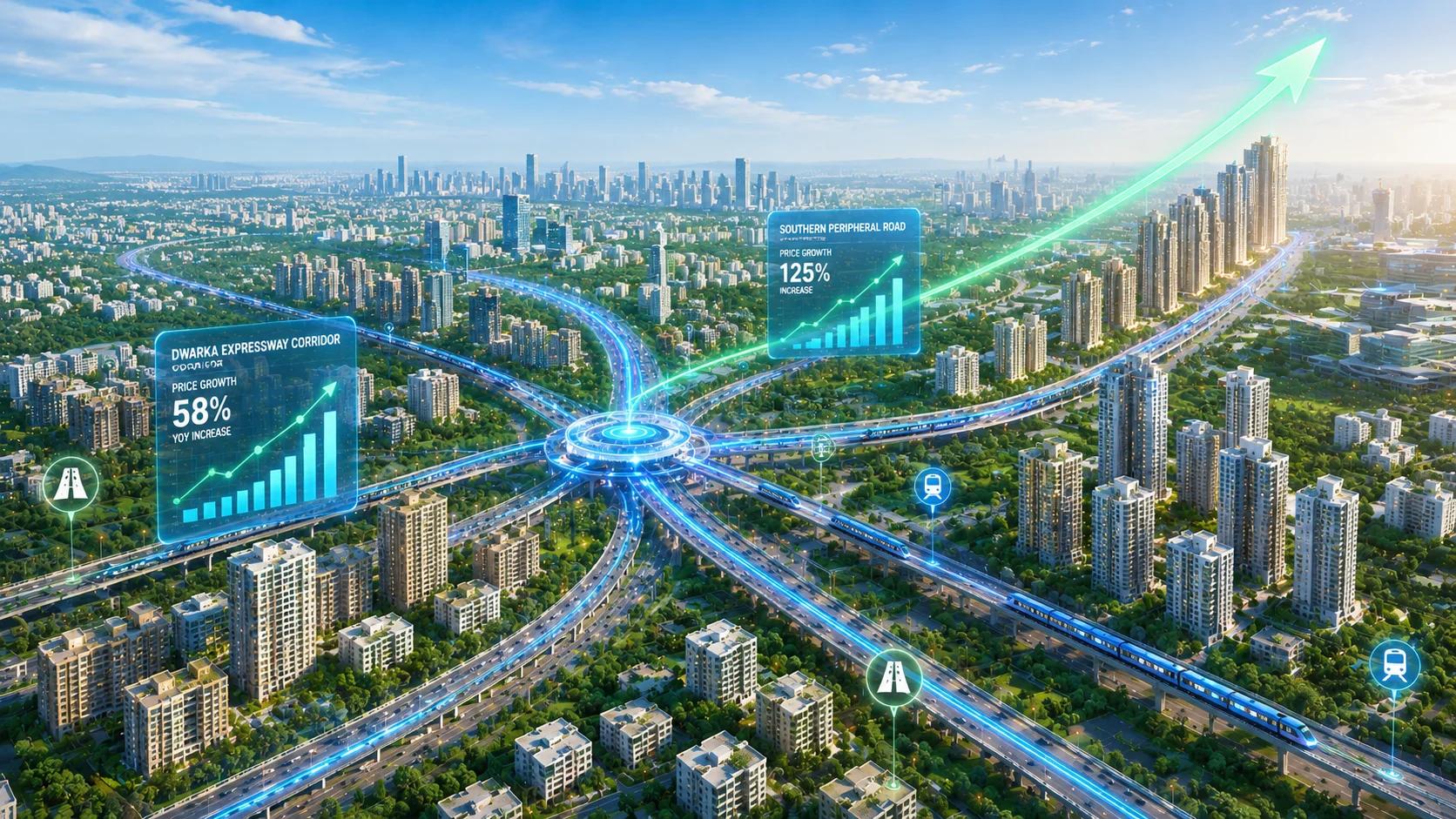
Launch prices along this corridor rose from ₹9,434 per sq ft in 2020 to ₹18,668 per sq ft in 2024. The cost of an average 3-BHK flat surged from ₹1.8 crore in 2022 to ₹2.64 crore in 2025.
In Q4 2024 and Q1 2025 alone, housing prices in this corridor recorded a 58% year-on-year increase, the steepest appreciation across all property markets in India.
What caused this? The biggest turning point was the operationalization of major expressway stretches, which drastically improved connectivity between Gurugram, Dwarka, Delhi's urban core, and IGI Airport.
The Dwarka Expressway Metro extension is also under active planning and is projected to be operational between 2026 and 2027, which means this corridor still has another leg of appreciation ahead of it.
For investors who entered early, the returns have been extraordinary. For buyers still on the fence, the question is whether the next phase of infrastructure completion will drive another round of gains.
Southern Peripheral Road: The Quiet Overachiever
While Dwarka Expressway grabbed the headlines, the Southern Peripheral Road (SPR) has been quietly delivering some of the most consistent appreciation in Gurugram.
Property prices along the SPR surged nearly 125% between December 2022 and December 2025, with average prices now exceeding ₹17,000 per sq ft.
Residential values along SPR rose sharply from around ₹7,690 per sq ft in 2020 to nearly ₹17,300 per sq ft, and the demand has been premium. SPR accounted for nearly 39% of Gurugram's ultra-luxury housing sales in H1 2025, with Gurugram itself contributing 91% of all luxury home sales in Delhi-NCR during the period.
The sustained price appreciation along the SPR is being driven by rapid infrastructure development and the strong presence of reputed developers, which has enhanced the corridor's appeal among homebuyers seeking organised, future-ready residential ecosystems.
The Gurugram Metropolitan Development Authority (GMDA) has also approved a new design for the Vatika Chowk cloverleaf, linking both ends of the elevated SPR at Sohna Highway. The 5.3-km elevated stretch from Vatika Chowk to NH-48, costing around ₹750 crore, will enable seamless connectivity from Sector 58 to Sector 115.
For investors looking at 2025 and beyond, SPR Gurgaon is expected to deliver annual returns of 12 to 18% on capital appreciation over the next 3 to 5 years, especially for early-stage investments in under-construction or newly launched projects.
Golf Course Extension Road: Where Infrastructure Meets Luxury
Golf Course Extension Road (GCER) is another compelling example of infrastructure-led value creation.
The average rate on GCER moved from ₹24,855 per sq ft in 2024 to ₹37,899 per sq ft in 2025, with the same period seeing a 379% increase in sales, meaning the total worth of homes sold in this belt rose sharply in just one year.
Property price trends on Golf Course Extension Road indicate 30 to 70% annual appreciation, while rental yields have moved up by 18% in just one year.
What is fuelling this? Infrastructure on multiple fronts. GCER stands to benefit from the approved 64 km Namo Bharat RRTS network, which is planned to connect with the proposed metro line. In Sector 66, the municipal corporation has also taken up a ₹7.4 crore model road with footpaths, cycle tracks, stormwater drains, sewerage lines, solar lighting, and modern road markings.
With the operational Rapid Metro and planned metro extensions along SPR, commuting to Cyber City or IGI Airport has become faster and more reliable, further boosting residential absorption along the corridor.
Metro Expansion: The Consistent Price Driver Across Gurugram
Across all of Gurugram's micro-markets, one infrastructure element stands out as the most consistent price driver: the metro.
Metro expansion in Gurugram is no longer just a supporting factor. It is a core pricing driver. From premium corridors like Golf Course Road to emerging zones like Golf Course Extension Road and Dwarka Expressway, metro connectivity directly influences who buys, who rents, and how fast prices move.
Metro access does not just raise prices, it changes the buyer profile and the pricing ceiling. Areas with confirmed metro connectivity attract a different, more creditworthy and higher-income buyer base, which pushes average transaction values up across the board.
The metro expansion is expected to further accelerate property value trends. Developers have already launched over 25,000 new housing units along the corridor, with more projects in the pipeline.
The key takeaway for buyers is straightforward: if a new metro line is announced or under construction near an area you are evaluating, that is a strong signal to act sooner rather than later.
Sohna Road: The Emerging Frontier Backed by Expressway Connectivity
Sohna Road represents a slightly different infrastructure story, one where appreciation is still in its earlier stages, making it attractive for investors who want to enter before the big price jump.
Real estate in Sohna is still relatively affordable at around ₹10,000 to ₹12,000 per sq ft, making it a highly attractive investment opportunity for new entrants. Massive infrastructure projects such as the operational Delhi-Mumbai Expressway, the IMT Sohna industrial zone, and the upcoming world's largest jungle safari have catapulted this region into the spotlight. Analysts anticipate 1.5x to 1.6x appreciation by 2030, supported by job-led housing demand and robust connectivity.
For buyers priced out of Golf Course Road or Dwarka Expressway, Sohna Road offers a genuine opportunity to benefit from the next wave of infrastructure-led appreciation.
What the Numbers Tell Us: Infrastructure Works
The data across Gurugram's corridors tells a consistent story.
Every single corridor that has received major infrastructure investment has delivered strong property price appreciation. Not occasionally. Not in isolated pockets. Every time, across every corridor, infrastructure has moved the needle on prices.
Peripheral corridors like the Dwarka Expressway saw prices nearly double, up 93% from 2019 to 2024. And analysts project 8 to 12% price appreciation in 2025 for mid-city sectors, driven by metro expansion and road upgrades.
Infrastructure has long been the silent architect of real estate growth, shaping not just property prices but the very desirability of neighbourhoods. Improved connectivity reduces commute times, raises accessibility, and sets expectations for better civic and social amenities, thereby fuelling both end-user and investor demand.
How to Use Infrastructure Signals as an Investor
Understanding the infrastructure-price relationship is one thing. Using it smartly as an investor is another. Here is a practical framework:
Watch for announcement-stage opportunities
Property prices rise in phases, and the biggest gains often go to those who buy when a project is announced, not when it opens. If a metro station or expressway is announced near an area, evaluate quickly.
Focus on last-mile connectivity, not just the big project
A sector 2 km from a metro station with no footpaths or autos is not the same as one 500 metres away with good last-mile access. Infrastructure quality at the micro level matters as much as the headline project.
Look at what else is coming
Infrastructure rarely arrives alone. An expressway brings commercial development. Commercial development brings jobs. Jobs bring housing demand. Track the full chain, not just the road.
Give weight to projects with confirmed funding and timelines
Announced but unfunded projects have a mixed track record in India. Projects with NHAI, GMDA, or state government backing and active construction are far more reliable bets.
The Road Ahead for Gurugram
Gurugram's growth corridors are playing a defining role in the city's real estate evolution, with connectivity emerging as the biggest growth catalyst. Key infrastructure projects such as Dwarka Expressway, Southern Peripheral Road, Golf Course Extension Road, and metro expansion have significantly enhanced accessibility and opened new investment hotspots. As Gurugram continues to expand, well-connected micro-markets will remain the cornerstone of sustained real estate growth and appreciation.
The city is not done growing. With the Namo Bharat RRTS, further metro extensions, elevated road corridors, and Sohna's continued development all in the pipeline, Gurugram's infrastructure story has several more chapters still to be written.
For buyers and investors, the message is clear: follow the infrastructure, and you follow the money.