Everyone who researches SCO plots in Gurgaon eventually arrives at the same question: once the building is ready, how much will it actually put in my bank account every month?
It is the right question to ask first, because an SCO plot is not just a piece of land. It is an income-generating asset that you build, tenant, and hold. The rental income it produces is what justifies the investment, funds your construction costs over time, and determines whether the whole exercise made financial sense.
The honest answer is that rental income from a developed SCO plot in Gurgaon varies quite significantly, depending on the sector, the plot size, the floor configuration, and the quality of tenants you attract. This guide gives you the real numbers across all these variables so you can make an informed decision before you buy or build.
First, Understand Why SCO Rental Income Is Different From Regular Commercial Units
Before getting into the numbers, it is worth understanding what makes SCO rental income structurally superior to most other commercial formats.
When you buy a shop in a mall or an office unit in a commercial tower, you have one tenant and one rental stream. When that tenant leaves, your income drops to zero while you hunt for a replacement.
A developed SCO plot with its basement, ground floor, and multiple upper floors gives you multiple independent tenants, multiple rental streams, and a diversified income base from a single asset. One floor vacating does not stop the income from the other four.
SCO plots offer rental returns of 8 to 10%, compared to just 2 to 3% for residential flats. The mix of retail and office tenants on the same property ensures higher occupancy rates and consistent cash flow.
That structural advantage, multiple tenants, multiple floors, one freehold asset, is what makes a well-developed SCO plot one of the most powerful income-generating investments in Gurgaon's current market.
The Floor-by-Floor Rental Reality: What Each Level Earns
The single most important thing to understand about SCO rental income is that different floors command dramatically different rents. Understanding this floor-by-floor reality is essential before you either buy a plot or design your building.
Ground floor retail commands Rs 120 to Rs 250 per sq ft per month in Gurgaon's high-demand SCO corridors. Upper floors for offices earn Rs 60 to Rs 120 per sq ft per month. Annual net yield after operating costs runs 7 to 11% on developed value, with long-term leases to premium brands delivering 8 to 12% stabilised yield.
Here is what that looks like in practice across a typical SCO building:
| Floor | Typical Use | Rent Per Sq Ft Per Month | Why This Rate |
|---|---|---|---|
| Basement | Parking / Storage | Rs 15 to Rs 30 | Limited commercial use, mostly support function |
| Ground Floor | Retail / Showroom / F&B | Rs 120 to Rs 250 | Highest footfall, street visibility, premium brands |
| First Floor | Retail Extension / Clinic | Rs 80 to Rs 130 | Good visibility, slightly lower than ground |
| Second Floor | Office / Co-working | Rs 60 to Rs 100 | Office use, stable tenants, longer leases |
| Third Floor | Office / Studio / Salon | Rs 50 to Rs 90 | Reduced footfall premium, still strong demand |
| Fourth Floor | Office / Service Business | Rs 45 to Rs 80 | Lowest floor premium, compensated by office stability |
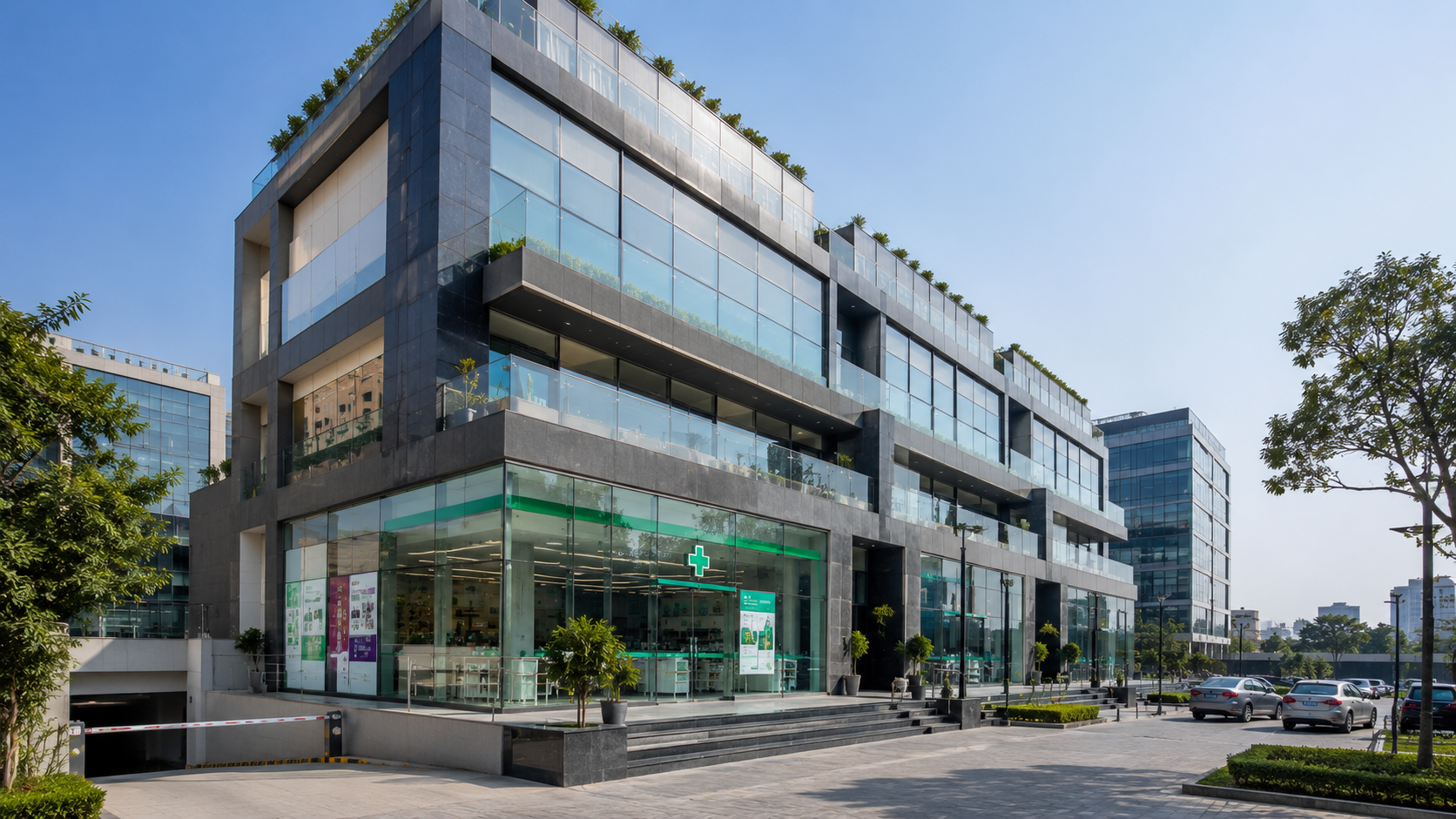
The ground floor is where the income is made. A well-located ground floor retail unit in a high-footfall sector of Gurgaon leased to a bank branch, pharmacy chain, or branded food outlet is the most valuable single commercial space you can own in this city relative to its sq ft footprint.
Real Monthly Income Calculations: What Different Plot Sizes Actually Earn
Now let us translate those per-sq-ft numbers into actual monthly income figures for the plot sizes most commonly available in Gurgaon's SCO market.
A standard SCO building on a 100 sq yard plot, developed to B+G+4 configuration, typically yields a total built-up area of approximately 3,500 to 4,000 sq ft across all floors.
For a 100 sq yard SCO plot on Sector 88A / Dwarka Expressway: the plot generates monthly rent potential of Rs 1.1 lakh to Rs 2.25 lakh depending on tenant quality and floor occupancy. A 129 sq yard plot generates Rs 1.4 lakh to Rs 2.9 lakh per month.
Let us break that down floor by floor for a 100 sq yard plot on a high-demand corridor:
| Floor | Approx. Carpet Area | Rent Per Sq Ft | Monthly Income |
|---|---|---|---|
| Ground Floor | 450 sq ft | Rs 180/sq ft | Rs 81,000 |
| First Floor | 450 sq ft | Rs 100/sq ft | Rs 45,000 |
| Second Floor | 450 sq ft | Rs 80/sq ft | Rs 36,000 |
| Third Floor | 450 sq ft | Rs 70/sq ft | Rs 31,500 |
| Fourth Floor | 450 sq ft | Rs 60/sq ft | Rs 27,000 |
| Total | 2,250 sq ft | - | Rs 2,20,500/month |
At full occupancy on a prime Dwarka Expressway or Golf Course Extension Road SCO, a well-developed 100 sq yard plot can realistically generate Rs 2 to Rs 2.25 lakh per month.
On a 150 sq yard plot, scale these figures by approximately 1.5X, giving you Rs 3 to Rs 3.5 lakh per month at full occupancy on a premium corridor. On a 200 sq yard plot, expect Rs 4 to Rs 5 lakh per month at full occupancy in the best-located sectors.
Corridor-by-Corridor Rental Income Comparison
Not all sectors perform equally. Location is the single biggest determinant of what rent your SCO can command and how quickly you attract quality tenants. Here is how the major SCO corridors compare:
| Corridor | Ground Floor Rent | Upper Floor Rent | Blended Yield | Best Tenant Profile |
|---|---|---|---|---|
| Golf Course Extension Road | Rs 180 to Rs 250/sq ft | Rs 90 to Rs 130/sq ft | 8 to 10% | Luxury brands, clinics, boutique offices |
| Dwarka Expressway (Sec 88A, 114) | Rs 120 to Rs 200/sq ft | Rs 70 to Rs 120/sq ft | 8 to 11% | Banks, pharmacies, F&B, startups |
| Sector 67 / MG Road | Rs 150 to Rs 220/sq ft | Rs 80 to Rs 120/sq ft | 7 to 9% | Established retail, clinics, co-working |
| Southern Peripheral Road | Rs 130 to Rs 180/sq ft | Rs 70 to Rs 110/sq ft | 7 to 9% | Corporate offices, branded retail |
| New Gurgaon (Sec 82 to 93) | Rs 80 to Rs 150/sq ft | Rs 50 to Rs 90/sq ft | 6 to 8% | Essential services, neighbourhood retail |
| Sohna Road (Emerging Sectors) | Rs 60 to Rs 120/sq ft | Rs 40 to Rs 70/sq ft | 6 to 8% | Local businesses, emerging brand tenants |
Golf Course Extension Road and the Dwarka Expressway belt, particularly Sectors 88A and 114, currently deliver the strongest combination of ground floor rental rates and tenant quality for SCO investors in 2026.
What Tenant Profile Does for Your SCO Income
The rent per sq ft numbers above are ranges, and where your SCO lands within that range depends almost entirely on the tenants you attract.
A pharmacy chain like MedPlus or Apollo Pharmacy on your ground floor will pay Rs 160 to Rs 200 per sq ft per month, sign a 5-year lease, include an escalation clause of 12 to 15% every three years, and maintain the unit to brand standards. You barely need to manage the tenancy.
A local kirana store or unknown retail business on the same ground floor might pay Rs 90 to Rs 110 per sq ft, no escalation clause, a 1-year renewable agreement, and a much higher risk of vacancy or default.
The difference between these two tenants on a 450 sq ft ground floor unit is approximately Rs 27,000 to Rs 40,000 per month just on one floor. Across five years with escalation, it compounds dramatically.
How to Attract Premium Tenants
Design the ground floor for retail from the outset: double height, wide frontage, minimal internal columns, and clear signage visibility from the road. Branded chains have specific criteria for the spaces they lease, and meeting those criteria is what separates a high-yield SCO from a mediocre one.
Also ensure adequate parking. Good parking is essential for retail and office success, and lack of parking can reduce footfall and tenant interest significantly. An SCO with a properly developed basement parking facility will consistently command higher rents and attract better tenants than one without.
The Annual Yield in Rupees: How SCO Compares to Everything Else
To put SCO rental income in context, here is how it compares to other investment formats at a similar capital value:
| Investment Type | Capital Deployed | Monthly Income | Annual Yield |
|---|---|---|---|
| 100 Sq Yd SCO Plot (developed) | Rs 4 to Rs 5 Cr | Rs 1.8 to Rs 2.2 lakh | 7 to 11% |
| Residential 3 BHK (Dwarka Exp) | Rs 3.5 Cr | Rs 35,000 to Rs 50,000 | 1.5 to 2% |
| Commercial Shop in Mall | Rs 2.5 Cr | Rs 75,000 to Rs 1 lakh | 4 to 6% |
| Grade-A Office Unit | Rs 5 Cr | Rs 2 to Rs 3 lakh | 6 to 8% |
| Fixed Deposit (7% annual) | Rs 4 Cr | Rs 2.33 lakh | 7% |
The SCO plot matches or beats a fixed deposit on income and additionally gives you capital appreciation on a freehold land asset and multi-tenant diversification that a fixed deposit cannot come close to offering.
The Honest Caveats: What Can Reduce Your SCO Rental Income
No honest guide on SCO rental income would be complete without acknowledging what can go wrong.
Vacancy between tenants. If a tenant vacates and finding a replacement takes two to three months, that is two to three months of zero income from that floor. Build a cash buffer that covers at least six months of expected income before you develop.
Construction timeline overruns. Rental income only starts once construction is complete and tenants are in. If development takes longer than planned, which it often does, your timeline to income gets pushed back. Budget conservatively on construction timelines.
Oversupply in newer sectors. In sectors where many SCO plots have been developed simultaneously, vacancy rates can be higher and rents lower than in more established corridors. Research the existing commercial supply in your sector before buying.
Lease negotiation reality. The per-sq-ft rates quoted in this guide represent achievable market rates for well-located, well-designed SCOs with premium tenant profiles. Poorly located or poorly designed buildings will lease at the lower end of the range or below it.