Vastu Shastra is the ancient Indian science of architecture that aligns a building's design, direction, and room placement with the five natural elements and the eight cardinal directions to create a harmonious flow of positive energy. It is important for homebuyers because a Vastu-compliant home is believed to support health, wealth, peace of mind, and family harmony, while a poorly aligned property can introduce avoidable obstacles. Before buying a flat or house in India, evaluating Vastu factors such as the main entrance direction, the orientation of the kitchen and master bedroom, and the placement of the pooja room is considered essential for long-term wellbeing.
When families in India sit down to choose a home, two questions almost always come up alongside price and location: which direction does the main door face, and is the flat Vastu compliant. For first-time buyers and even seasoned investors, this is not superstition. It is a 5,000-year-old design framework that has guided how Indians build and inhabit spaces, and it continues to shape buying decisions across the country.
This guide explains what Vastu Shastra actually is, why it matters when you buy a home, and the practical checks you can run on any property before you sign the agreement.
What is Vastu Shastra?
Vastu Shastra, often shortened to Vastu, is the traditional Indian system of architecture and design that originates from the Vedic texts. The word itself comes from Sanskrit: vastu means dwelling or building site, and shastra means science or knowledge. Together, it is the science of dwelling.
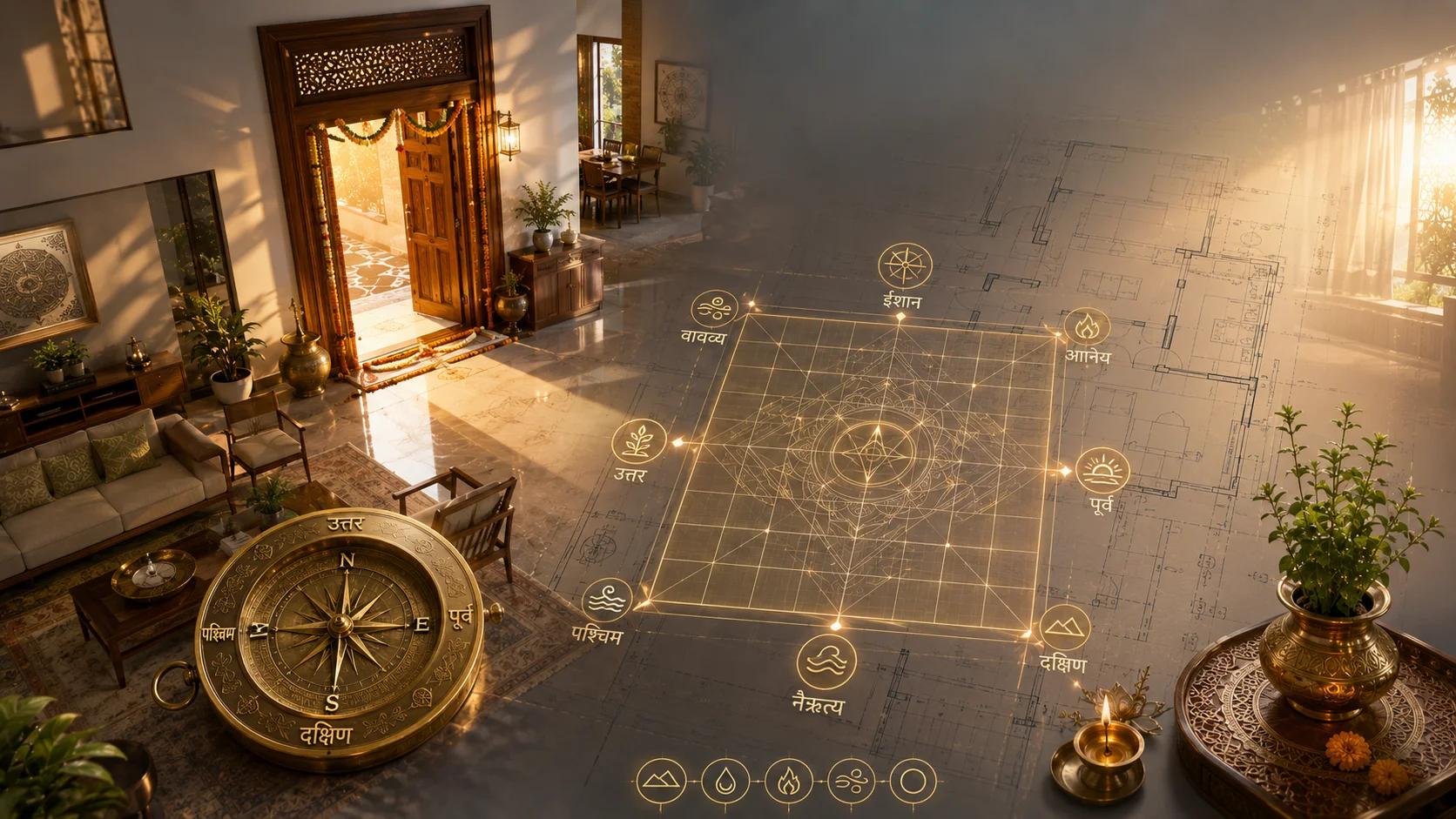
At its core, Vastu is built on the belief that every space carries an energy of its own, and that this energy is shaped by the interaction of five natural elements (earth, water, fire, air, and space) with the eight cardinal and intercardinal directions (north, east, south, west, northeast, northwest, southeast, and southwest). When a home's design respects these natural forces, the energy inside it flows freely and supports the people who live there. When it works against them, the inhabitants may experience friction in their health, finances, and relationships.
Vastu is not a religion. It is a design philosophy that pre-dates modern town planning by millennia, and many of its principles, such as cross-ventilation, natural light, and the orientation of openings, align with what contemporary architects also recommend. Hindu, Jain, Buddhist, and even some early Islamic structures across the subcontinent show Vastu influence in their layouts.
The Core Principles of Vastu
Five ideas sit at the foundation of every Vastu recommendation. Understanding them helps you read a floor plan with a Vastu lens rather than memorising rules.
1. The Five Elements (Pancha Mahabhuta)
Every space is influenced by earth (stability), water (flow and prosperity), fire (energy and transformation), air (movement), and space (expansion). A balanced home gives each element its rightful zone.
2. The Eight Directions
Each direction is governed by a deity and carries a specific quality. The northeast is the zone of clarity and water; the southeast governs fire; the southwest holds earth and stability; the northwest is the zone of air and movement. These are not arbitrary; they map to how sunlight, wind, and magnetic forces behave across a 24-hour day.
3. The Vastu Purusha Mandala
This is the geometric grid that underlies every Vastu plan, dividing the building site into 9x9 or 8x8 squares. The mandala represents a cosmic being whose body the home is built upon, with each zone supporting a specific activity such as cooking, sleeping, or worship.
4. The Flow of Energy (Prana)
Vastu treats a home like a living body. Energy must enter cleanly through the main door, circulate without obstruction through living areas, and exit gracefully. Clutter, dead corners, and misplaced heavy furniture interrupt this flow.
5. Harmony with the Occupants
A Vastu-compliant home is not a one-size-fits-all design. The orientation that suits one family may not suit another. The age, profession, and birth charts of the occupants are sometimes factored in for a personalized reading.
Why Vastu is Important When You Buy a Home
For Indian homebuyers, Vastu matters for reasons that go well beyond tradition.
It Influences Daily Wellbeing
A home built with natural light entering from the east, kitchen heat radiating away from the bedrooms, and a clutter-free entrance is simply a better place to live. Many Vastu rules encode practical environmental wisdom that improves how a home feels day after day.
It Affects Resale Value
Vastu-compliant properties hold their value better in the Indian resale market. A flat with a south-facing main door, a kitchen in the wrong corner, or a toilet in the northeast typically sells at a discount of five to fifteen percent compared to a comparable Vastu-compliant unit in the same building. For an investor, this is not a soft factor. It is a measurable hit to liquidity.
It Supports Prosperity and Growth
The directional placement of the entrance, the safe, the kitchen, and the master bedroom is believed to directly influence financial inflow, career stability, and family harmony. Generations of Indian families have observed that homes aligned with Vastu principles tend to support the upward trajectory of their occupants.
It Brings Mental Peace and Confidence
When you live in a home that you believe is energetically right, you carry that confidence into your work and relationships. The psychological benefit of Vastu compliance is real, regardless of how one explains the mechanism.
It is Increasingly Expected by Buyers
Across metros and tier-2 cities, a growing share of buyers actively filter for Vastu compliance during their property search. Developers have responded by designing layouts with Vastu in mind, and listing portals now highlight Vastu-friendly features as a selling point.
The Most Important Vastu Factors When Buying a Property
Not every Vastu rule carries equal weight. When you are evaluating a flat or a house, focus on the factors that have the strongest impact on daily life and long-term resale.
1. The Direction of the Main Entrance
The main door is the single most important element in Vastu. It is the mouth of the home through which all energy enters. The most auspicious directions for a main entrance are north, east, northeast, and west. A north-facing entrance is governed by Kubera, the lord of wealth, and is associated with financial growth. An east-facing entrance brings the energy of the rising sun, supporting health and clarity. Northeast entrances combine both benefits and are widely considered the most powerful.
South-facing main doors are traditionally considered less favourable, but they are not automatically inauspicious. The exact pada (subdivision within the direction) determines the outcome, and a well-placed entrance in the southeast portion of a south-facing wall can perform beautifully.
2. The Orientation of the Kitchen
The kitchen is the fire zone of the home, and Vastu places it in the southeast. The cook should ideally face east while preparing food. A kitchen in the northeast is one of the strongest Vastu defects to avoid, as it places fire in the water zone and can disturb both health and finances.
3. The Master Bedroom
The southwest corner is the seat of stability and is the recommended placement for the master bedroom. This direction is governed by the earth element and supports rest, long-term security, and the authority of the head of the household. Sleeping with the head pointing south or east is also considered favourable.
4. The Pooja Room
The northeast is the most sacred direction in Vastu and is the natural home for the pooja room. This is the zone where positive energy enters first, and dedicating it to worship amplifies the spiritual atmosphere of the entire home.
5. Toilets and Storage
Toilets are best placed in the northwest or west. A toilet in the northeast or southeast is considered a serious Vastu defect because it pollutes the most sensitive energy zones. Heavy storage and almirahs belong in the southwest, where their weight reinforces the earth element of stability.
6. Natural Light and Ventilation
Vastu favours homes that receive abundant morning light from the east and northeast. Cross-ventilation between windows allows air, the carrier of prana, to circulate freely. A flat with deep, dark interiors and minimal natural light is a Vastu concern regardless of how favourable its other directions may be.
Vastu Checklist for Buying a Flat or House
Use this practical checklist when you visit a property. It covers the high-impact factors most buyers can evaluate without a specialist.
| Vastu Factor | Ideal | Acceptable | Avoid |
|---|---|---|---|
| Main entrance direction | North, East, Northeast | West, Northwest | Southwest |
| Kitchen location | Southeast | Northwest | Northeast |
| Master bedroom | Southwest | South, West | Northeast |
| Pooja room | Northeast | East, North | South, Southwest |
| Toilets | Northwest, West | South | Northeast, Southeast |
| Living room | North, East, Northeast | Northwest | Southwest |
| Children's bedroom | West, Northwest | South | Center of the home |
| Staircase | South, West, Southwest | Northwest | Northeast, Center |
| Water tank (underground) | Northeast | North, East | Southwest, Southeast |
| Open balcony | North, East, Northeast | West | South, Southwest |
When a property scores well on the first four rows of this table, the rest is usually manageable through interior remedies. When the first four go wrong, remedies become significantly harder.
Common Vastu Defects and How They Can Be Remedied
No flat is perfect. Even Vastu-compliant designs sometimes have one or two zones that fall short. The good news is that most defects have known remedies that experienced Vastu consultants can prescribe.
Misaligned Main Entrance
If the door cannot be physically moved, remedies include placing a brass or copper Vastu pyramid near the entrance, hanging a metal wind chime to break stagnant energy, and ensuring the entryway is always well-lit and clutter-free.
Kitchen in the Wrong Zone
A northeast kitchen is the hardest defect to fix structurally, but its effects can be softened by placing the cooking stove in the southeast corner of that kitchen, keeping the sink and stove apart, and using earthen colours on the walls.
Toilet in the Northeast
This is one of the most discussed Vastu defects. Common remedies include keeping the toilet door closed at all times, placing a sea-salt bowl inside, painting the walls in light blue or white, and avoiding the use of this toilet whenever possible.
Irregular Plot or Flat Shape
Square and rectangular layouts are ideal. For L-shaped or oddly cornered flats, mirrors and bright lighting in the missing zones help complete the energy field. In severe cases, partition adjustments during interior work can recover the shape.
Missing Northeast Corner
The northeast is too important to leave deficient. Remedies include placing a small water feature, an aquarium, or a tulsi plant in the northeast area available to you, and using light pastel colours on the northeast-facing walls.
What to Ask Before You Finalise a Property
A short conversation with the developer's sales team and a fifteen-minute compass check on site can save you from buying a home with deep Vastu defects.
- Stand at the main door and ask which direction you are facing as you step out. This is the facing direction of the flat.
- Walk through the floor plan and identify where the kitchen, master bedroom, pooja room, and toilets fall on the eight-direction grid.
- Ask the developer whether the project was designed with Vastu inputs. Many reputable developers now build with Vastu consultation, especially in residential towers.
- Bring a smartphone compass or, ideally, a hand-held magnetic compass for accuracy.
- If you are seriously considering the property, invest in one paid consultation with a qualified Vastu expert before booking. The fee is small compared to the cost of buying a home that does not support you.
The Bottom Line
Vastu Shastra is not a superstition you tolerate to keep the family happy. It is a layered design framework that has guided Indian homes for thousands of years and continues to influence how families choose where to live and how those homes hold their value over time. When you evaluate a property with a Vastu lens, you are buying a home that supports your wellbeing, your finances, and your peace of mind, not just a unit on a floor plan.
If you are evaluating a flat or house in Gurgaon or the NCR and want a second opinion on its Vastu alignment alongside the usual location, price, and developer checks, our team at Realty Canvas helps homebuyers run integrated property assessments before purchase. The right home is one that works for you in every dimension that matters.