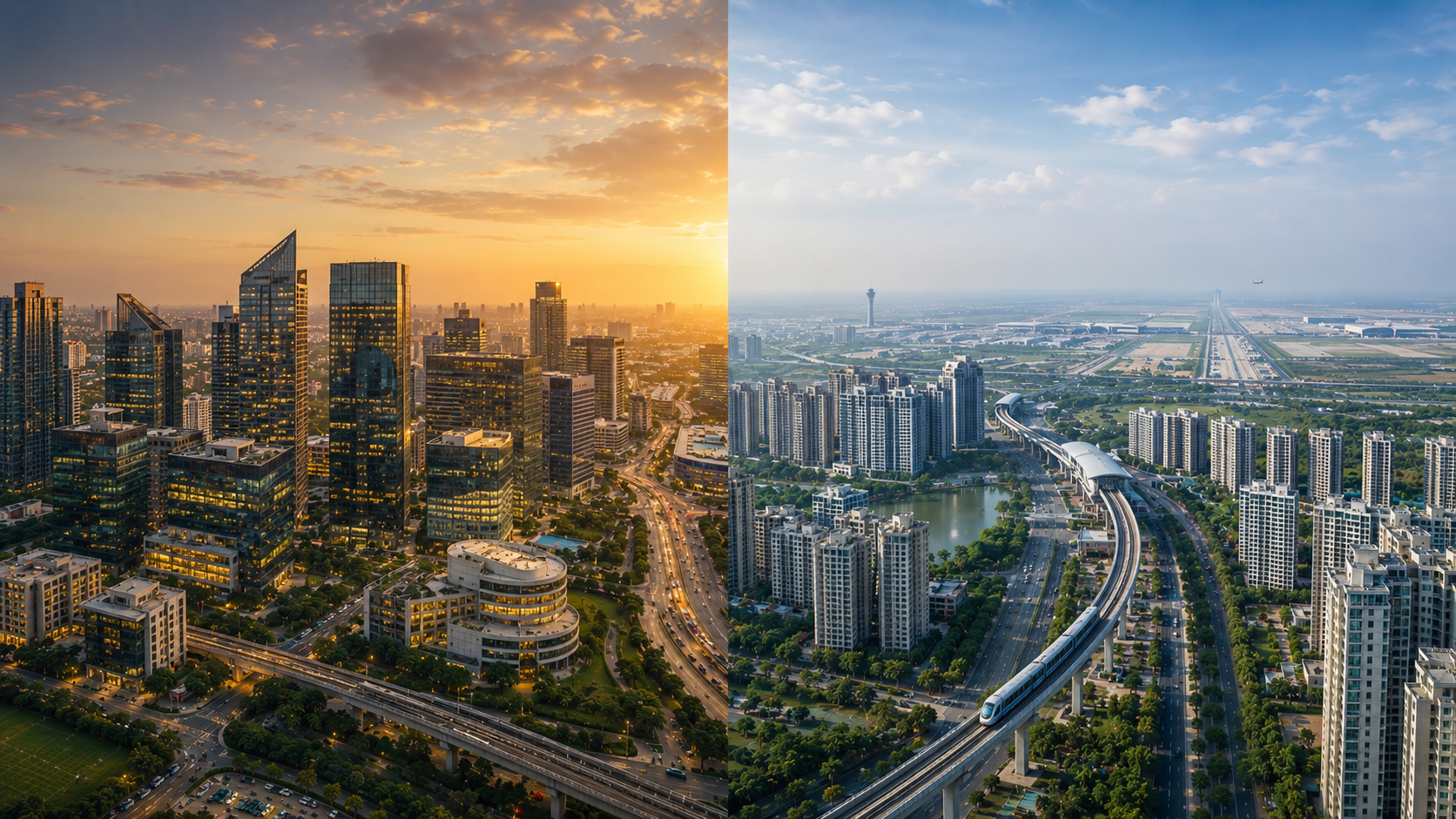
This is one of the most common questions asked by property investors and end-users across NCR. Gurgaon or Noida? The two cities have been competing for buyer attention for over two decades, and in 2026 they represent genuinely different real estate propositions, not just geographically, but in terms of buyer profile, pricing trajectory, developer credibility, and return potential.
Here is a thorough, data-grounded comparison to help you decide.
Market Positioning: What Each City Actually Represents
Before comparing numbers, it helps to understand what kind of market each city is.
Gurgaon is a private-sector-led city. The infrastructure, the employment base, the commercial real estate, and the premium residential development have all been driven by corporate India and private developers. DLF, Godrej, M3M, Emaar, and Signature Global, these names define the city's skyline and set the pricing benchmark. Gurgaon's identity is aspirational and corporate. It attracts buyers who want proximity to MNC offices, premium social infrastructure, and a Tier 1 residential address.
Noida is more planning-commission-led. The Noida Authority and Greater Noida Authority have historically controlled land supply and development rights. This gave Noida more structured sector development but also exposed buyers to the severe project delay crisis of 2012 to 2022, when hundreds of under-construction projects stalled across Noida and Greater Noida. That crisis has scarred buyer sentiment in ways that are still visible in 2026.
These origin differences matter enormously when comparing returns.
Price Comparison: Where Each Market Stands in 2026
Gurgaon pricing at mid-2026 benchmarks:
- Golf Course Road: Rs 26,000 to Rs 32,000 per sq ft
- Golf Course Extension Road: approximately Rs 37,899 per sq ft
- Dwarka Expressway: approximately Rs 18,668 per sq ft
- Southern Peripheral Road: Rs 17,000-plus per sq ft
- Sohna Road: Rs 8,000 to Rs 14,000 per sq ft
Noida pricing at mid-2026 benchmarks:
- Noida Expressway (Sectors 125 to 150): Rs 10,000 to Rs 16,000 per sq ft
- Greater Noida West (Noida Extension): Rs 5,000 to Rs 8,000 per sq ft
- Yamuna Expressway: Rs 4,000 to Rs 7,000 per sq ft
- Central Noida (Sectors 44 to 78): Rs 12,000 to Rs 18,000 per sq ft
Noida is significantly more affordable on a per-square-foot basis across comparable product categories. But the more important question is not where prices are today; it is where they are going, and why.
Infrastructure Momentum: Which City Has More to Gain
Infrastructure is the single biggest driver of real estate returns in NCR, and the two cities are at very different stages of their infrastructure journeys.
Gurgaon's infrastructure is maturing. The Dwarka Expressway is fully operational. The Delhi-Mumbai Expressway connectivity is active. The Golf Course Road and Cyber City belt is established. What this means for prices is that much of the infrastructure-led appreciation in Gurgaon's premium corridors has already happened. Future price growth will be driven by demand-supply dynamics, developer quality, and possession delivery, not fresh infrastructure discovery.
Noida's infrastructure pipeline is active and large. The Jewar International Airport (Noida International Airport) is the defining infrastructure event for the Yamuna Expressway belt. With commercial operations expected in the coming years, the airport corridor is generating significant land and residential buying activity. Additionally, the Aqua Line Metro extension, Phase 4 Delhi Metro connectivity, and the Film City development at Sector 21 in Greater Noida are all catalysts that are still ahead of the pricing curve.
If pure infrastructure-led appreciation is what you are after, Noida's pipeline arguably has more uncaptured upside in specific pockets, particularly the Yamuna Expressway.
Developer Credibility and Delivery Track Record
This is where Gurgaon maintains a meaningful advantage in 2026.
The Noida project stall crisis of the 2010s involved dozens of developers, including Jaypee, Amrapali, Unitech, and many others, leaving thousands of buyers without homes for eight to fourteen years. Supreme Court interventions, RERA complaints, and insolvency proceedings became defining features of that market. While RERA has improved the landscape and many projects have now seen resolution, the reputational damage to Noida as a market has not fully recovered.
In Gurgaon, while the overall market has not been entirely immune to delays, the premium developer ecosystem, DLF, Godrej Properties, M3M, and Signature Global, has maintained relative credibility on delivery timelines, especially for projects launched post-2019. The under-construction risk in Gurgaon is concentrated in mid-tier and fringe developers, whereas the premium belt has delivered reasonably well.
For an end-user, this translates directly into peace of mind. For an investor, it translates into better resale liquidity, because buyers entering the secondary market in Gurgaon face less fear about title clarity or possession uncertainty.
Rental Yield and Investor Returns
On rental yield, Noida is increasingly competitive.
Gurgaon rental yields run 2.5% to 3.5% on residential properties in established corridors, with premium addresses commanding slightly lower yields because capital values have outpaced rental growth.
Noida rental yields run 3% to 4% in well-connected sectors like the Noida Expressway belt and sectors near Metro connectivity. With Noida's employment base expanding, including Samsung, HCL, TCS, and a growing startup ecosystem, rental demand in well-located sectors is genuine and growing.
For a pure rental-yield play, Noida offers a slight edge. But yield calculations alone are incomplete; capital appreciation over the hold period matters equally for total returns. Here, Gurgaon's established corridors offer more predictability, while Noida's infrastructure-adjacent pockets offer higher upside but with higher uncertainty.
On the capital appreciation trajectory: in Gurgaon's premium belt (GCR, GCER), prices have appreciated 30 to 45% over the 2021 to 2024 period. A further 15 to 20% appreciation over the next two to three years is the realistic scenario in these corridors, assuming macro stability.
In Noida's Expressway belt, appreciation over the same 2021 to 2024 period has been 20 to 35% in well-performing projects. The Yamuna Expressway belt has seen sharper upward movement on airport-linked speculation. Future upside in the next three to five years, if airport timelines are met, could outperform Gurgaon's established corridors, but that upside is conditional on infrastructure delivery.
Who Should Choose Which City
The Gurgaon vs Noida answer depends on who the buyer is.
Choose Gurgaon if:
- You work in or near Cyber City, DLF Avenue, or the broader Gurugram corporate corridor.
- You want a premium branded address with established social infrastructure, schools, hospitals, and malls.
- You are an NRI wanting a recognisable, liquid asset in an established market.
- You value developer credibility and possession certainty over price-point value.
- You are upgrading from an existing Gurgaon property and want to stay within the ecosystem.
- Your budget is Rs 1.5 crore and above, and you want city-proven appreciation fundamentals.
Choose Noida if:
- You work in the Noida or Greater Noida tech corridor and want to reduce commute significantly.
- You are a yield-focused investor prioritising rental income over capital appreciation predictability.
- You want maximum square footage and amenity quality at a given budget.
- You are an early-stage investor willing to hold five to seven years for airport-linked corridor appreciation.
- Your budget is below Rs 1 crore, and you want a serious residential address with Metro connectivity.