
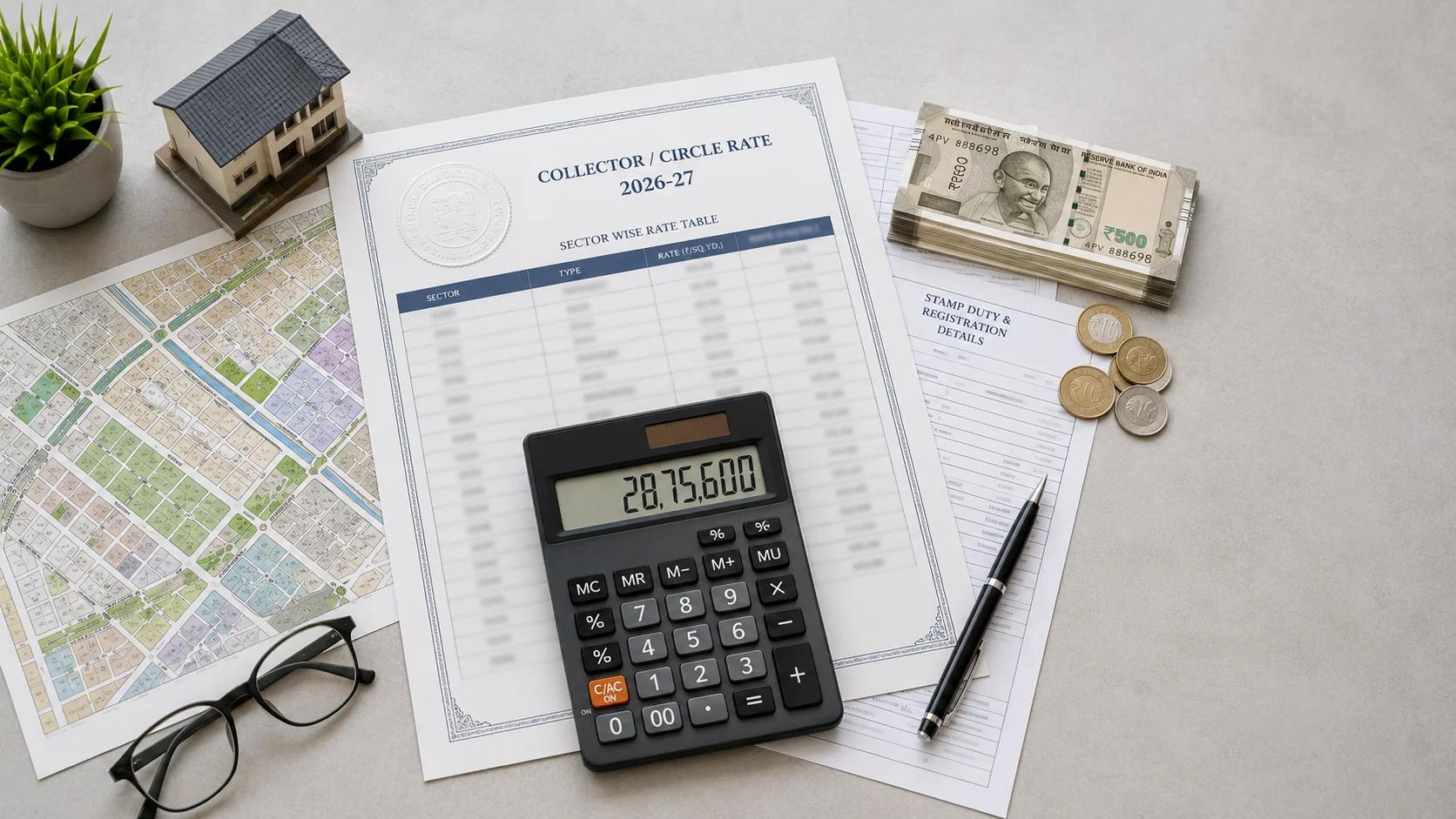
The Gurgaon circle rate hike 2026, effective April 1, has increased property valuation benchmarks by 15% to 75% across sectors, directly impacting stamp duty, registration costs, and overall property prices. Dwarka Expressway, SPR-linked sectors, and DLF Phase V saw the steepest hikes, while established areas like Sector 29 saw more moderate increases. Stamp duty is calculated on whichever is higher, the circle rate or your actual transaction price, so this revision raises your minimum registration cost regardless of what you negotiate with the seller.
What Is a Circle Rate and Why Does Haryana Revise It?
Circle rates in Gurgaon are the minimum property values set by the government, below which a property cannot be registered. These rates ensure standardisation in property pricing and prevent undervaluation in real estate transactions.
Collector Rate, also known as Circle Rate, is the minimum benchmark valuation fixed by the government for property registration. It establishes the baseline on which stamp duty and related registration costs are assessed. Even where parties negotiate a lower consideration figure, registration authorities examine whether the stated value falls below the applicable benchmark and may refuse to register at the lower value.
Revisions happen periodically, not every year, and are driven primarily by one factor: closing the gap between official valuation and real market transaction values.
What Changed in the Gurgaon Circle Rate Revision 2026?
The Haryana government has increased circle rates by 15 to 30 per cent across key residential, commercial, and agricultural zones, with select high-growth sectors seeing hikes of up to 75 percent, effective from April 1, 2026.
The new circle rate in Gurgaon from April 2026 kept nearly half of the areas unchanged, placed many locations in the 15 to 30% band, and touched 75% in certain rapidly changing zones.
The primary driver behind the revision is the need to align official property valuations with actual market prices. Over time, the gap between circle rates and real transaction values had widened significantly, reducing transparency in property deals. The revision also reflects the impact of large-scale infrastructure projects, including the Dwarka Expressway, metro expansion, and improvements along SPR, all of which have significantly enhanced land value.
This is not a routine annual tweak. It is one of the sharpest single revisions in the city's history, and it is directly tied to infrastructure delivery rather than blanket inflation adjustment.
Which Sectors Saw the Biggest Increase?
Sectors that saw the highest Gurgaon circle rate hike 2026 include Dwarka Expressway-linked Sectors 104 to 115, Sectors 9 and 9A for commercial land, and SPR-linked Sectors 63, 63A, 64, and 67.
Established locations like Sector 29 are seeing more moderate increases, while places like Dwarka Expressway and DLF-linked premium zones are seeing much sharper revision.
| Zone | Circle Rate Movement | Why |
|---|---|---|
| Dwarka Expressway (Sec 104 to 115) | Among the steepest, up to 75% | Expressway operational, metro and RRTS incoming |
| SPR-linked sectors (63, 63A, 64, 67) | High increase | Premium developer concentration, rapid appreciation |
| Commercial land Sec 9, 9A | Significant hike | Rising commercial demand |
| DLF Phase V | Sharp revision | Premium resale values already far above old circle rate |
| Sector 29 and other established zones | 15 to 30%, moderate | Mature pricing, smaller official-vs-market gap |
How Does the New Circle Rate Affect Stamp Duty?
Stamp duty in Haryana is 7% for male ownership, 5% for female ownership, and 6% for joint ownership, while registration charges are 1%.
Stamp duty is calculated on the higher of the two values, between the actual transaction price and the collector rate, to prevent undervaluation of property during registration. So even if the buyer can negotiate a price below the market value, the buyer must still pay the stamp duty based on the government-set value.
Here is what this means with real numbers. Suppose the official circle rate of a property rises from ₹80,000 to ₹1,24,700 per sq yard. Even if the deal value is negotiated well, the registration base itself becomes much higher.
Stamp Duty Calculation Example
| Scenario | Old Circle Rate Base | New Circle Rate Base (post-2026) | Stamp Duty Impact (7% male ownership) |
|---|---|---|---|
| ₹80,000/sq yd to ₹1,24,700/sq yd (56% hike) | ₹80,000 | ₹1,24,700 | Duty rises proportionally on the new base, regardless of negotiated price |
First-time purchasers should note that the hike can raise the upfront amount paid at the time of documentation. This can increase the down payment and the loan amount in some cases. These costs can take the total outgo to nearly 6 to 8% of the revised base.
For a ₹1.5 crore apartment, additional legal and tax outflow can go up to ₹11 to 12 lakh. Post-revision, budget this figure higher on Dwarka Expressway and SPR-linked sectors specifically.
How Does This Affect Resale Property Owners?
For years, many Gurgaon locations had a large difference between market value and official registration value. That gap helped some buyers save on registration-related costs, but it also created valuation distortion.
If you are selling a resale property, this revision is broadly favourable. It formally validates higher transaction values, which supports your asking price and reduces buyer pushback during negotiation, since the registration floor itself has moved up.
If you are buying resale, expect sellers in high-revision sectors to hold firmer on price, since they now have an official benchmark supporting it.
Will This Push Market Prices Up Too?
Circle rate hike can lead to a rise in Gurgaon property prices in 2026, depending on the location, segment, demand, and supply. Prime areas and luxury properties already carry asking sums much above the revised government rates.
In a higher official-value environment, the margin for casual speculative entry reduces. Buyers need better project selection, smarter payment structure, and stronger holding capacity. If official values rise sharply, weaker projects lose the affordability cushion that underpricing sometimes provided. Strong projects may still absorb demand, but weaker inventory may struggle.
The key distinction: in premium corridors where market rates already sit far above the old circle rate, this revision changes registration cost but not market pricing dynamics much. In emerging or weaker projects where market and circle rates were close together, this revision pushes the effective entry cost up meaningfully.
What Should Homebuyers Do Now?
This revision signals a transition toward a more transparent and value-aligned market environment. Practically, that means three things for any buyer transacting in 2026.
Check the exact revised circle rate for your specific sector, not the city-wide average, before budgeting, since the range runs from 0% to 75% depending on location. Verify your sector's rate through the official District Gurugram website, under the 'Final Collector Rate Year 2026-27' section. Factor the full 6 to 8% registration cost into your total budget upfront, not as an afterthought after price negotiation. And recognise that in high-revision sectors like Dwarka Expressway and SPR, the official cost floor has now risen permanently. Waiting will not bring it back down.